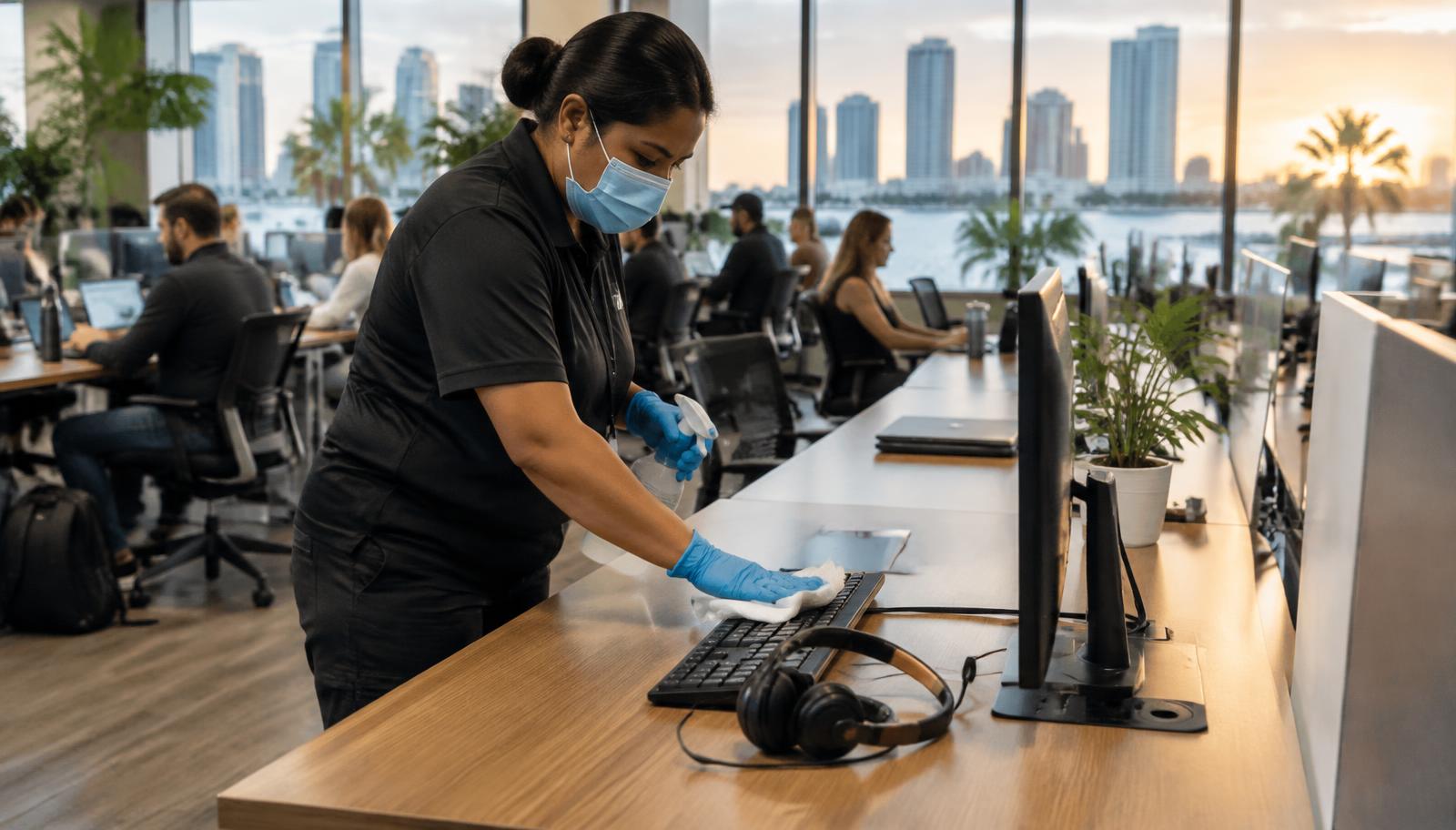
By Florida Commercial Cleaning · Published · Updated
Why flu season is a business problem, not just a health problem
The CDC estimates influenza has caused between 9 million and 41 million illnesses, 120,000 to 710,000 hospitalizations and 6,000 to 52,000 deaths each year in the United States since 2010. Every one of those cases started somewhere — and for working adults, that somewhere is very often the office, the job site or the restaurant shift.
Adults with flu can be contagious from about a day before symptoms start to five to seven days after. That means the employee who 'feels a little off' on Monday has already been touching keyboards, coffee pots, elevator buttons and conference tables across Downtown Tampa, Westshore, Brandon or Riverview before anyone knows they are sick.
In Florida, flu activity typically builds in December and peaks between December and February, though our climate can stretch the season. For Tampa Bay employers, that window overlaps with year-end deadlines, holiday dining rushes and peak snowbird hotel occupancy — exactly when a wave of absences hurts most.
How long flu and other winter germs survive on surfaces
Respiratory droplets are the main route, but surfaces are the bridge between people who never share a room at the same time — the night-shift worker and the day-shift worker, last night's hotel guest and tonight's.
- Influenza A/B — paper, cloth8–12 hrs
- Influenza A/B — steel, plastic24–48 hrs
- RSV — countertopsup to ~6 hrs
- Norovirus — hard surfacesup to 2 weeks
Upper-range estimates from CDC and peer-reviewed laboratory studies. Real-world survival varies with temperature, humidity and surface type. Bar lengths use a square-root scale.
Facility risk matrix: where close quarters turn into outbreaks
Not every building carries the same risk. Density, shared equipment and visitor turnover are what drive it. This is how we rate common Tampa Bay facility types when we build a flu-season cleaning scope.
| Facility type | Main exposure driver | Highest-risk touchpoints | Recommended disinfection |
|---|---|---|---|
| Coworking / hot-desk | Strangers rotating through the same desks daily | Shared desks, phone booths, kitchen taps, printers | Daily + midday porter |
| Open-plan office | Dense seating, shared air all day | Keyboards, mice, conference tables, door pulls | Nightly + weekly deep |
| Call center | Close seating, constant talking | Headsets, phones, armrests, badge readers | Nightly, per-shift wipe-down |
| Corporate HQ | Cross-department meetings and visitors | Elevator buttons, lobby desks, boardrooms | Nightly + day porter |
| Data center | Small, critical teams; one absence = risk | Access panels, shared consoles, break rooms | Scheduled, moisture-controlled |
| Hotel / hospitality | New guests in the same rooms continuously | Remotes, light switches, handles, phones | Every turnover |
| Restaurant / kitchen | Public dining plus food-handling staff | Menus, tables, POS screens, prep surfaces | Between seatings + close |
Coworking spaces and open offices: the hot-desk problem
Coworking floors in Downtown Tampa, Ybor, Westshore and Water Street concentrate dozens of companies — and their germs — on shared furniture. Hot desks are the worst case: a different person may sit at the same desk every day, using the same monitor arm, power outlet and chair.
Open-plan offices in Brandon, Wesley Chapel, Lutz and Westchase face the same issue at a slower pace. Without walls, one coughing employee shares air and surfaces with everyone in their row, and break rooms become the daily mixing point for the whole building.
- Disinfect every desk surface, keyboard tray, phone and chair arm nightly — not just 'the dirty ones.'
- Add a midday day porter during peak flu weeks to reset kitchens, restrooms and door hardware.
- Supply wipe stations and hand sanitizer at hot-desk zones and phone booths.
Call centers and corporate headquarters
Call centers combine everything flu likes: tight seating, hours of talking, shared headsets and rotating shifts. One infected agent can expose a whole pod in a week. Headsets and handsets need disinfection between users, not once a week.
Corporate headquarters move people between floors and departments all day. Elevator panels, lobby check-in desks, boardroom tables and shared AV remotes link departments that otherwise never meet — which is why one sick executive assistant can take out a leadership team before a board meeting.
Data centers: when a small team can't afford absences
Data centers in the Tampa Bay area often run lean, highly specialized crews. If flu takes out two of four on-site technicians, uptime is at risk. Disinfection there must also respect the equipment: no overspray, no dripping liquid near racks, low-lint materials and controlled entry.
We disinfect break rooms, restrooms, NOC consoles, access panels and shared tools on a scheduled, moisture-controlled protocol, documented for your compliance file. See our full data center cleaning service for the SOP.
Hotels and hospitality: strangers in the same room, over and over
A hotel room is a shared space with a delay. Every guest touches the remote, the light switches, the thermostat, the phone, the nightstand and the bathroom fixtures — and the next guest arrives hours later, well inside the 24–48 hour survival window for flu on hard surfaces.
From downtown Tampa and Channelside to Clearwater Beach and St. Petersburg, Tampa Bay hotels run high occupancy through winter. A visible, documented disinfection routine on every turnover is both a health measure and a guest-confidence measure.
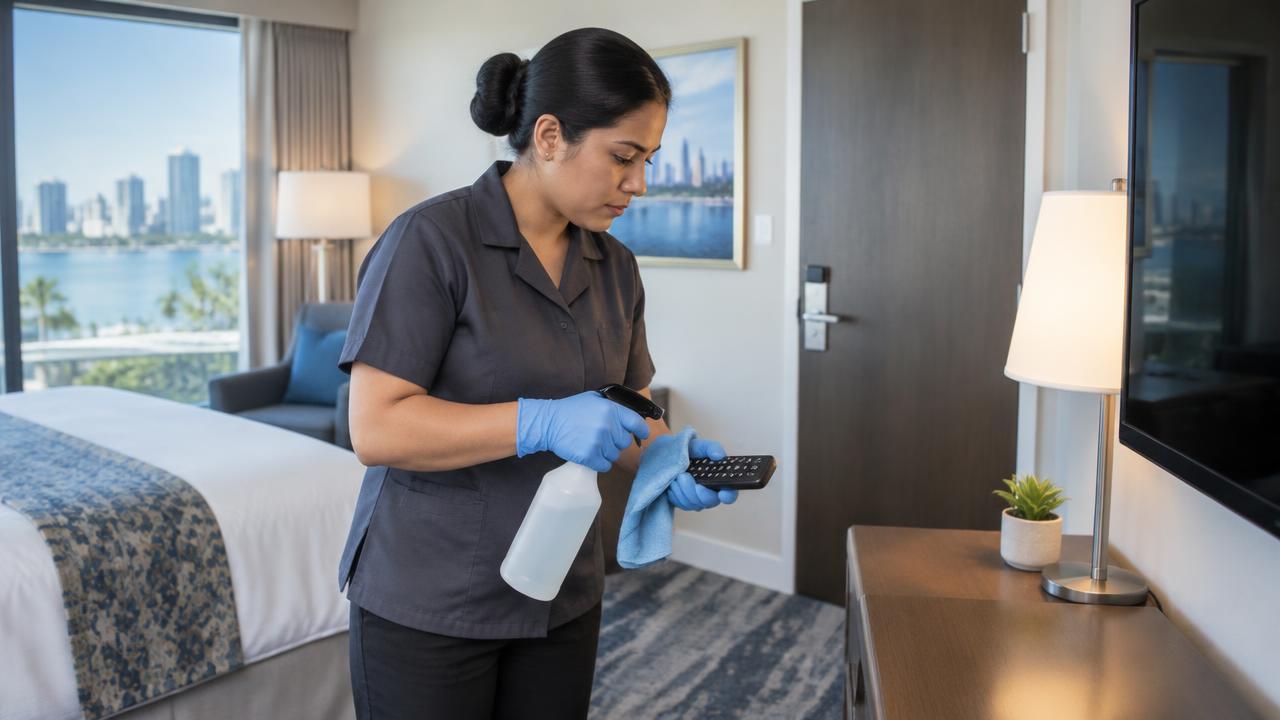
Hotel Cleaning in Downtown Tampa Florida - Florida Commercial Cleaning Services
A hotel cleaning job in downtown Tampa. Hotels run on first impressions, so the guest-facing areas get the most attention: the lobby and entrance glass, corridors and elevator cabs, public restrooms, and common areas like fitness rooms and meeting spaces — all cleaned on a schedule that works around check-in, check-out and occupancy. Downtown Tampa hotels sit in the middle of the convention and event traffic, so this kind of recurring service keeps every floor ready for the next arrival.
Restaurants and commercial kitchens: two different chemistries
Restaurants in Tampa, Brandon, Plant City, Riverview and Apollo Beach serve the public and handle food, which means two jobs at once. Dining-room touchpoints — menus, tables, chairs, POS screens, restroom doors — call for EPA-registered disinfectants with influenza claims. Food-contact surfaces require approved food-contact sanitizers used at the concentration the FDA Food Code and the product label specify.
Mixing those up is a common inspection problem: a strong disinfectant on a prep board can leave residue that must be rinsed, while a sanitizer on a restroom handle may not have a flu kill claim at all. Our crews use the right product for each zone and log it.
Our flu-season disinfection protocol
- Walkthrough and touchpoint map. We map every high-touch surface in your facility and set frequency by risk, not by habit.
- Clean first, then disinfect. Soil blocks disinfectants. Surfaces are cleaned before disinfecting, as CDC and EPA guidance require.
- EPA-registered disinfectants with influenza claims. Products are chosen from EPA-registered lists for the pathogens in season and applied exactly per label.
- Full wet contact time. Surfaces stay visibly wet for the label dwell time — typically 1 to 10 minutes — instead of spray-and-wipe.
- Food-contact sanitizers in kitchens and cafés. Approved no-rinse sanitizers on prep surfaces and break-room counters, tested for concentration.
- Color-coded microfiber. Separate cloths for restrooms, kitchens and offices so nothing travels between zones.
- Electrostatic application where it fits. Even coverage on cubicle panels, chairs and complex surfaces without pooling.
- Documentation. Every visit logs products, areas and times — useful for your HR file, insurer or health inspector.
Serving Tampa and the surrounding cities
Florida Commercial Cleaning provides flu-season disinfection and nightly janitorial service across Hillsborough County and Tampa Bay — Tampa, Brandon, Riverview, Valrico, Plant City, Ruskin, Apollo Beach, Lutz, Wesley Chapel, Temple Terrace and Westchase — plus St. Petersburg and Clearwater. Statewide and multi-site clients are covered through our priority response retainer.
Tampa Florida Overnight Janitorial And Commercial Cleaning Services
Overnight janitorial service in Tampa. The crew comes in after the building empties out, so cleaning never interrupts work: trash and recycling pulled, restrooms cleaned and restocked, break rooms and kitchens wiped down, desks and high-touch points dusted and disinfected, and floors vacuumed and mopped. Businesses choose overnight cleaning so employees and customers walk into a finished space every morning.
What it costs to wait
The CDC Foundation has estimated that flu costs U.S. employers roughly $7 billion a year in sick days and lost productivity. For a single Tampa office, a few days with a quarter of the staff out — or a hotel with negative reviews about guests getting sick — easily costs more than a full season of preventive disinfection. Schedule a free walkthrough before the peak, not during it.
Frequently asked questions
- How long does the flu virus live on office surfaces?
- Flu viruses can survive on hard, non-porous surfaces like stainless steel and plastic for up to 24–48 hours, and on paper or cloth for roughly 8–12 hours. That's why nightly disinfection of shared desks, phones and door hardware matters.
- Are your disinfectants EPA-registered?
- Yes. We use EPA-registered disinfectants with influenza claims on non-food surfaces, applied at the label contact time, and approved food-contact sanitizers in kitchens and break rooms.
- When is flu season in Tampa?
- Florida flu activity usually rises in December and peaks December through February, though it can start earlier or run later. Schedule enhanced disinfection before activity climbs.
- Do you clean coworking spaces and call centers in Tampa Bay?
- Yes — coworking spaces, open offices, call centers, corporate headquarters, data centers, hotels and restaurants across Tampa, Brandon, Riverview, Lutz, Wesley Chapel, Plant City and nearby cities.
- Can you disinfect after an employee tests positive for flu?
- Yes. We offer same-day or next-morning targeted disinfection of the person's workstation, shared areas and high-touch points, documented for your records.
- Is fogging alone enough?
- No. Surfaces must be cleaned first, and disinfectant must stay wet for the label contact time. Electrostatic spraying is a coverage tool, not a substitute for cleaning.
See the full plague disinfection and facility response guide, the biohazard response hub and our disinfection and outbreak response service.
Sources
Guidance on this page follows published public-health and regulatory sources. Verify current guidance before acting on anything time-sensitive.
- CDC — About estimated flu burden
- CDC — How flu spreads
- Florida Department of Health — Flu Review (influenza surveillance)
- Bean B. et al., Survival of influenza viruses on environmental surfaces, J Infect Dis 1982
- CDC — Norovirus: prevention
- CDC — Cleaning and disinfecting your facility
- EPA — Using disinfectants safely and effectively
- FDA — Food Code