Food safety response
Allergen Cross-Contact Cleaning & Undeclared-Allergen Recall Response
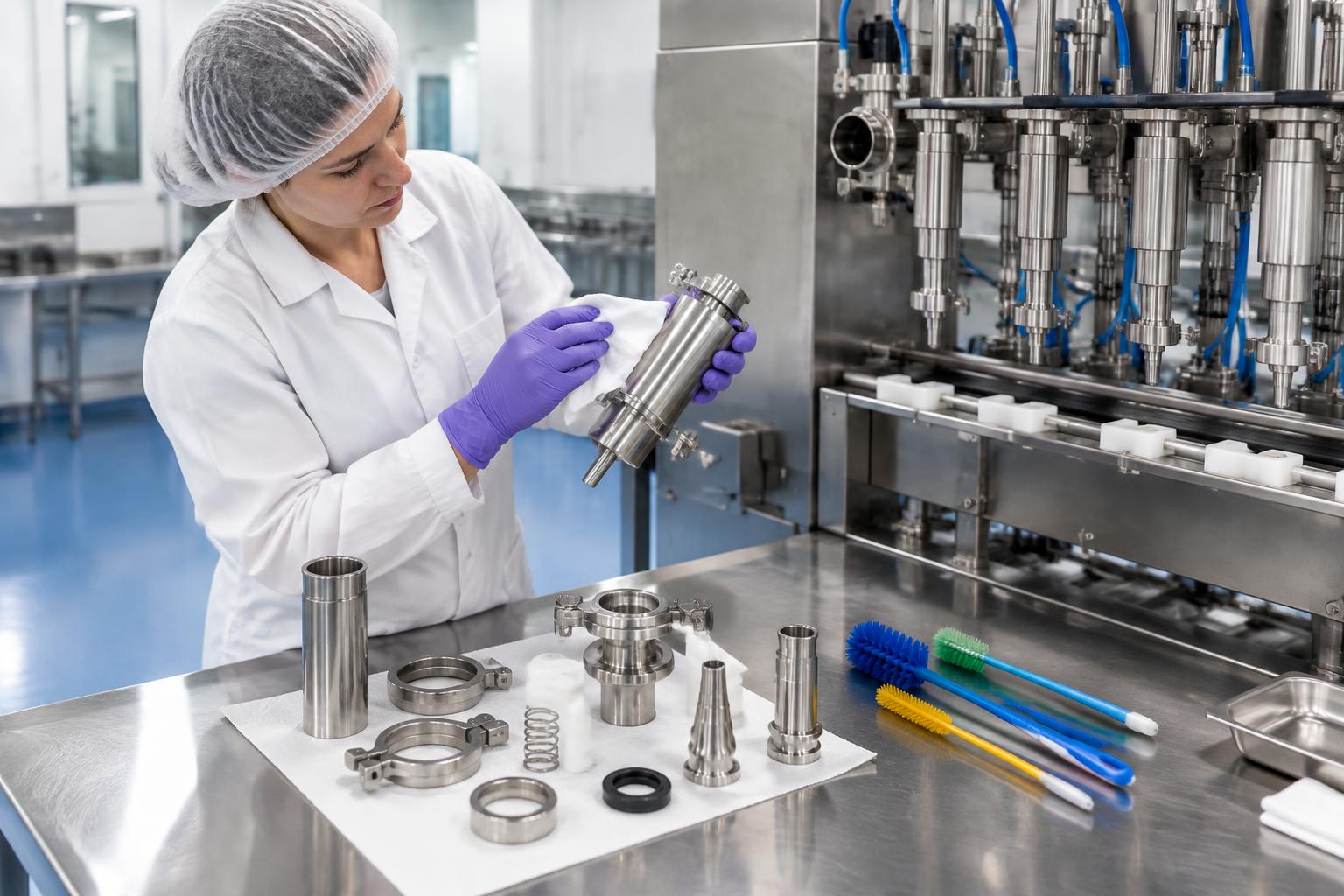
Undeclared allergens are one of the most common reasons for FDA food recalls. Sanitizers do not destroy allergen proteins — only physical removal does. That means full disassembly, wet or dry cleaning to remove every trace of residue, and verification with allergen-specific tests before the next run. We perform deep changeovers and recall cleanups with documentation that supports your allergen control plan.
9
Major food allergens under U.S. law, incl. sesame since 2023
Top cause
Undeclared allergens rank among the leading reasons for FDA recalls
0
Allergen proteins killed by sanitizer — they must be removed
~33M
Americans with food allergies (FARE)
Why sanitizing is not enough
Allergen proteins aren't living organisms — heat and sanitizer don't remove them. A line can pass ATP and microbiological testing and still carry enough peanut or milk protein to cause a reaction. Allergen changeovers demand disassembly and physical removal, verified with allergen-specific test kits.
Changeovers and recall cleanups
For co-packers running multiple customers' products, we supplement your sanitation crew on heavy changeovers. After an undeclared-allergen recall, we strip and clean the affected line top to bottom, replace or isolate porous parts as you direct, and document every step for your corrective-action file.
Return to operation
Our Allergens response & restart plan
1. Isolate & hold
Affected lines, rooms and product are tagged out. We map zones 1–4 with your QA lead so nothing is cleaned in the wrong order.
2. Dry pick-up & gross removal
Product, debris and soil removed. Dry facilities stay dry — HEPA vacuums and brushes, no water introduced where Salmonella risk is high.
3. Strip-down & foam wash
Guards, belts, scrapers and removable parts pulled. Alkaline or enzymatic foam breaks biofilm; top-down, back-to-front rinse.
4. Sanitize & disinfect
EPA-registered disinfectants on environmental surfaces and food-contact sanitizers at label concentration and full contact time, verified with test strips.
5. Verify
ATP swabs on every food-contact surface, with re-clean on any fail. Your lab or third party runs pathogen swabs; we re-treat positives.
6. Document & hand back
A written record of areas, chemistries, concentrations, dwell times, ATP readings and crew — the file your auditor, FDA, USDA FSIS or FDACS inspector asks for.
Source: CDC estimates of domestically acquired foodborne illness per year (Scallan et al., 2011).
Industries we serve
- Co-packers & private label
- Bakeries & confectionery
- Sauce, dressing & beverage plants
- Nut & seed processors
- Meal-kit and commissary kitchens
- Supplement manufacturers
Areas we dispatch to
- Tampa, FL
- Plant City, FL
- Brandon, FL
- Lakeland, FL
- St. Petersburg, FL
- Clearwater, FL
- Oldsmar, FL
- Largo, FL
- Pinellas Park, FL
- Zephyrhills, FL
- Lakewood Ranch, FL
- Orlando, FL
- Statewide Florida & nationwide by arrangement
Questions
Allergens response FAQ
- Do you run allergen verification tests?
- We can run rapid allergen swabs your QA team specifies, or support your own testing. Validation of your allergen cleaning program remains with your food safety team.
- Can you help with overnight changeovers?
- Yes, we supplement plant sanitation crews on heavy changeovers, nights and weekends.
- What about sesame?
- Sesame became the ninth major allergen in 2023 under the FASTER Act. It's sticky and oily — changeovers need extra attention on sifters, conveyors and depositors.
Sources
Guidance on this page follows published public-health and regulatory sources. Verify current guidance before acting on anything time-sensitive.
More food safety response
Other pathogens & recall scenarios
Allergens problem right now?
Call or text (813) 738-4220 — tell us the facility, the findings and the affected areas, and we'll scope and dispatch.