Food safety response
Norovirus Outbreak Disinfection for Restaurants, Hotels & Food Service
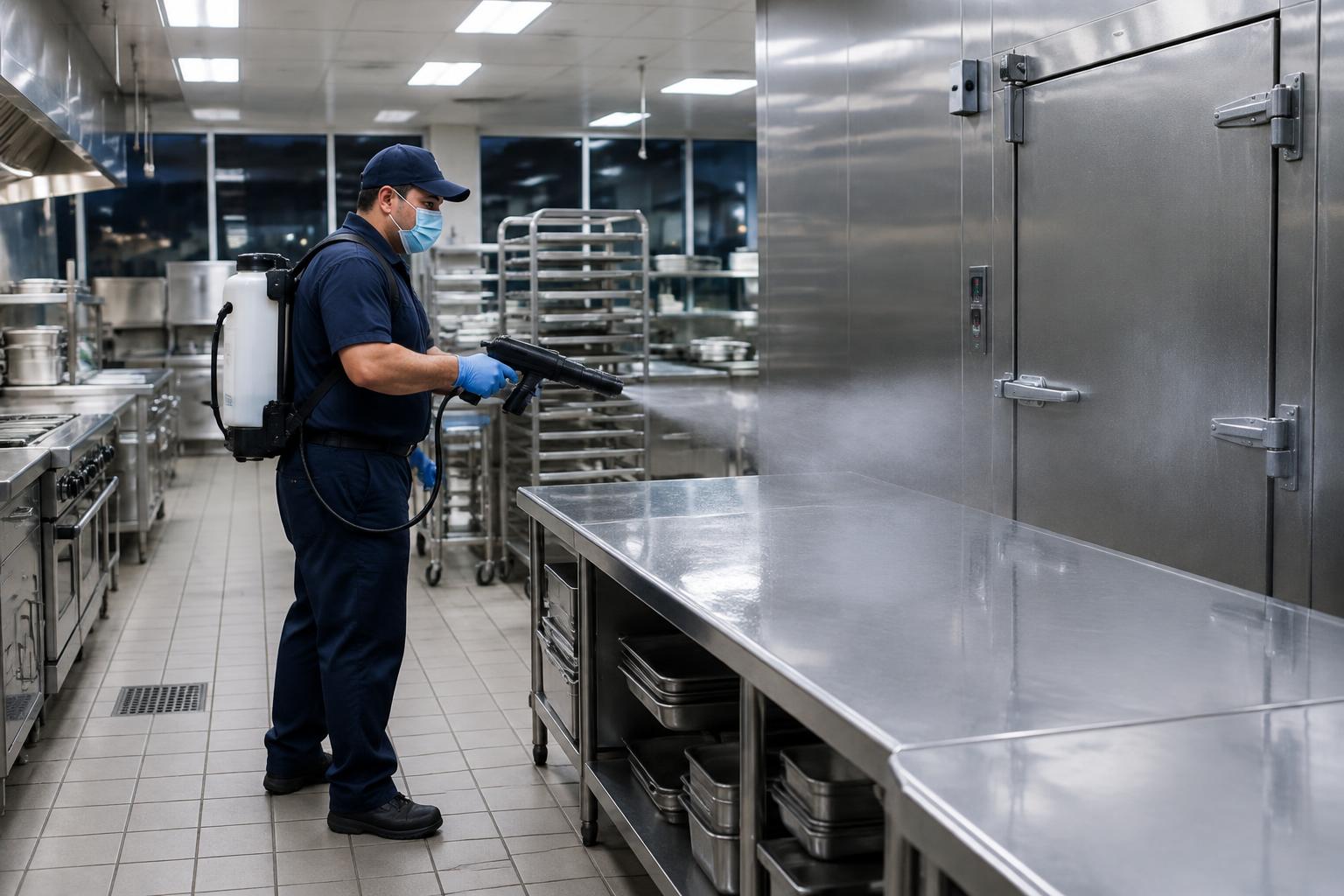
Norovirus causes more foodborne illness in the U.S. than any other pathogen, and most outbreaks start in food service with an ill food worker. It survives on surfaces for days to weeks and resists many common disinfectants. Outbreak response means closing the area, removing vomit and fecal contamination safely, and disinfecting kitchens, restrooms and guest areas with EPA-registered products on List G for norovirus.
58%
Of U.S. foodborne illnesses caused by norovirus (CDC)
~2,500
Norovirus outbreaks reported in the U.S. each year (CDC)
~70%
Of foodborne norovirus outbreaks traced to infected food workers (CDC)
2 weeks
Survival on surfaces
Why Florida hospitality is exposed
Tampa Bay hosts millions of visitors a year across beach resorts, convention hotels, stadium events and cruise departures from Port Tampa Bay. Norovirus moves fast in banquet kitchens, buffets and hotel rooms where strangers cycle through the same surfaces day after day.
Our outbreak protocol
Trained crews in PPE contain and remove vomit and fecal incidents using absorbent and List G disinfectant at full dwell time, then work through kitchens (food-contact surfaces re-sanitized after disinfection), restrooms, guest rooms and common areas. Soft surfaces are steam-treated. You receive written documentation for the health department follow-up.
Return to operation
Our Norovirus response & restart plan
1. Isolate & hold
Affected lines, rooms and product are tagged out. We map zones 1–4 with your QA lead so nothing is cleaned in the wrong order.
2. Dry pick-up & gross removal
Product, debris and soil removed. Dry facilities stay dry — HEPA vacuums and brushes, no water introduced where Salmonella risk is high.
3. Strip-down & foam wash
Guards, belts, scrapers and removable parts pulled. Alkaline or enzymatic foam breaks biofilm; top-down, back-to-front rinse.
4. Sanitize & disinfect
EPA-registered disinfectants on environmental surfaces and food-contact sanitizers at label concentration and full contact time, verified with test strips.
5. Verify
ATP swabs on every food-contact surface, with re-clean on any fail. Your lab or third party runs pathogen swabs; we re-treat positives.
6. Document & hand back
A written record of areas, chemistries, concentrations, dwell times, ATP readings and crew — the file your auditor, FDA, USDA FSIS or FDACS inspector asks for.
Source: CDC estimates of domestically acquired foodborne illness per year (Scallan et al., 2011).
Industries we serve
- Restaurants & QSR chains
- Hotels, resorts & banquet kitchens
- Catering & event venues
- Cruise terminals
- Senior living & healthcare dining
- School & university dining
Areas we dispatch to
- Tampa, FL
- Plant City, FL
- Brandon, FL
- Lakeland, FL
- St. Petersburg, FL
- Clearwater, FL
- Westshore, FL
- Channelside, FL
- St. Pete Beach, FL
- Sarasota, FL
- Orlando, FL
- Fort Lauderdale, FL
- Statewide Florida & nationwide by arrangement
Questions
Norovirus response FAQ
- Does hand sanitizer stop norovirus?
- Not reliably. Handwashing with soap and water is recommended. For surfaces, use an EPA List G product labelled for norovirus at full contact time.
- Can we stay open during cleanup?
- Affected areas should close until disinfected. We work overnight to minimise downtime and section off areas so unaffected parts can keep serving where appropriate.
- Do you clean hotel rooms after a guest illness?
- Yes — guest rooms, corridors, elevators, fitness and pool areas, plus banquet and kitchen spaces.
Sources
Guidance on this page follows published public-health and regulatory sources. Verify current guidance before acting on anything time-sensitive.
More food safety response
Other pathogens & recall scenarios
Norovirus problem right now?
Call or text (813) 738-4220 — tell us the facility, the findings and the affected areas, and we'll scope and dispatch.