Food safety response
Salmonella Decontamination for Food Manufacturers & Processors
Salmonella causes more U.S. foodborne hospitalizations and deaths than any other bacteria. It survives for months in dry environments like flour, spice, nut butter and snack plants, and spreads by cross-contamination in poultry, egg and produce operations. Response means controlled dry cleaning where water is the enemy, wet sanitation where it isn't, EPA-registered disinfection, and documented verification before restart.
~1.35M
U.S. Salmonella infections per year, all sources (CDC)
26,500
Hospitalizations per year (CDC)
#1
Bacterial cause of foodborne hospitalization and death
Months
Survival in dry, low-moisture environments
Dry facility vs wet facility — different rules
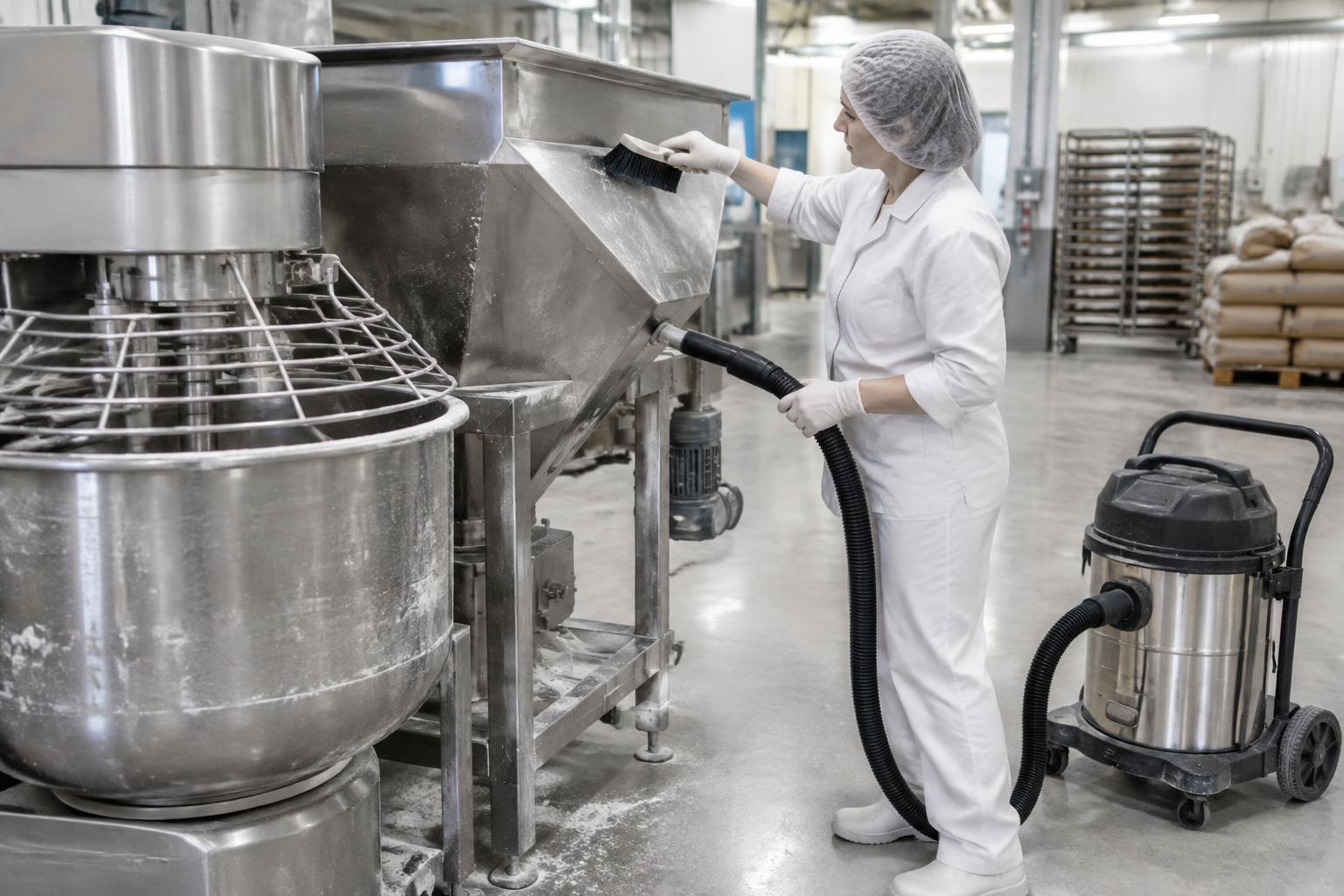
In a dry plant, washing down can make a Salmonella problem worse by giving dormant bacteria the moisture to multiply and by carrying it into cracks. We use controlled dry cleaning — HEPA vacuuming, dedicated brushes, dry steam where appropriate — and introduce minimal, controlled wet cleaning only where equipment design allows and it can be dried quickly.
In poultry, egg and produce facilities we run full wet sanitation: gross removal, foam detergent, rinse, sanitize, and strict raw-to-RTE zone separation with colour-coded tools.
Bringing a Florida plant back online
Central Florida's I-4 corridor — Tampa, Plant City, Lakeland, Auburndale and Winter Haven — is packed with bakeries, distribution centres, citrus and produce operations, where one positive can hold millions in product. Our crews work around your sanitation shifts, document every chemical and contact time, and support your corrective-action report.
Return to operation
Our Salmonella response & restart plan
1. Isolate & hold
Affected lines, rooms and product are tagged out. We map zones 1–4 with your QA lead so nothing is cleaned in the wrong order.
2. Dry pick-up & gross removal
Product, debris and soil removed. Dry facilities stay dry — HEPA vacuums and brushes, no water introduced where Salmonella risk is high.
3. Strip-down & foam wash
Guards, belts, scrapers and removable parts pulled. Alkaline or enzymatic foam breaks biofilm; top-down, back-to-front rinse.
4. Sanitize & disinfect
EPA-registered disinfectants on environmental surfaces and food-contact sanitizers at label concentration and full contact time, verified with test strips.
5. Verify
ATP swabs on every food-contact surface, with re-clean on any fail. Your lab or third party runs pathogen swabs; we re-treat positives.
6. Document & hand back
A written record of areas, chemistries, concentrations, dwell times, ATP readings and crew — the file your auditor, FDA, USDA FSIS or FDACS inspector asks for.
Source: CDC estimates of domestically acquired foodborne illness per year (Scallan et al., 2011).
Industries we serve
- Commercial bakeries
- Snack & cereal plants
- Spice & dry-blend co-packers
- Poultry & egg processing
- Produce packing houses
- Pet food & feed mills
Areas we dispatch to
- Tampa, FL
- Plant City, FL
- Brandon, FL
- Lakeland, FL
- St. Petersburg, FL
- Clearwater, FL
- Riverview, FL
- Bartow, FL
- Auburndale, FL
- Sarasota, FL
- Ocala, FL
- Orlando, FL
- Statewide Florida & nationwide by arrangement
Questions
Salmonella response FAQ
- Can you clean without water?
- Yes. Dry-plant protocols use HEPA vacuums, dry brushing and approved dry sanitizing methods so water isn't introduced where Salmonella risk is highest.
- Which disinfectants do you use?
- EPA-registered disinfectants labelled for Salmonella enterica on environmental surfaces, and food-contact sanitizers used at label concentration with test-strip verification.
- Do you serve poultry and egg operations?
- Yes, including raw-side sanitation, raw-to-RTE separation and equipment strip-downs, coordinated with your plant's SSOPs.
- Do you serve outside Tampa Bay?
- Yes — statewide Florida and nationwide by arrangement. Retainer clients get priority dispatch.
Sources
Guidance on this page follows published public-health and regulatory sources. Verify current guidance before acting on anything time-sensitive.
More food safety response
Other pathogens & recall scenarios
Salmonella problem right now?
Call or text (813) 738-4220 — tell us the facility, the findings and the affected areas, and we'll scope and dispatch.