Food safety response
Listeria Decontamination for Florida Food Plants & Cold Storage
Listeria monocytogenes grows at refrigeration temperatures and hides in wet, cold niches — floor drains, conveyor rollers, door gaskets, condensate pans and cracked flooring. A positive environmental swab means a full strip-down, biofilm removal and EPA-registered disinfection of the harbourage zone, followed by ATP verification and re-swabbing. We dispatch across Tampa Bay and Florida to get lines cleared and production restarted.
~1,600
U.S. listeriosis illnesses per year (CDC)
~260
Deaths per year — the highest fatality rate of common foodborne pathogens (CDC)
39°F
Listeria still grows at refrigerator temperature
Zero
Tolerance for Listeria in RTE products (USDA FSIS / FDA)
Why one positive swab can shut down a line
Under FDA and USDA programs, a Listeria positive on a food-contact surface (zone 1) can mean product hold, finished-product testing and possibly a recall. Positives in zones 2–4 are warnings that a harbourage niche is established nearby. Florida's heat and humidity drive condensation inside cold rooms, which is exactly the moisture Listeria needs.
Cleaning harder with the same routine rarely clears a persistent strain. The niche has to be found, opened up, and treated — often with disassembly your nightly sanitation crew doesn't have time for.
How we work a Listeria event
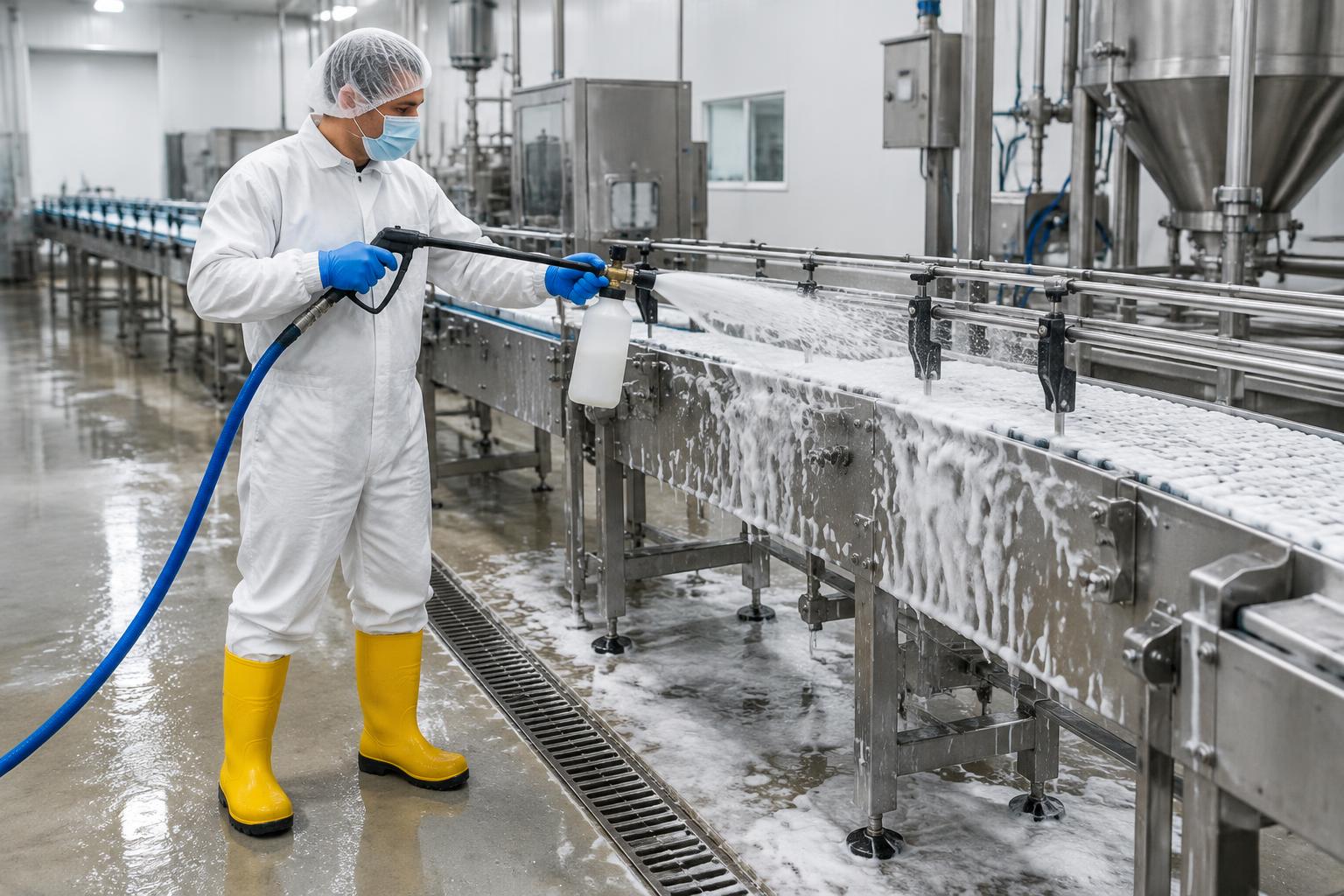
We start from your swab map and work outward from the positive: drains first (cleaned, brushed, foamed and treated — never pressure-sprayed into the air near exposed product), then equipment frames, rollers, gaskets and condensate systems. Removable parts go to a clean-out-of-place station; hollow members and bearings get extra attention.
Disinfection uses EPA-registered products labelled for Listeria monocytogenes on environmental surfaces, and food-contact sanitizers at the label concentration and contact time. We record every step so your QA team can show the corrective action to auditors (SQF, BRCGS) and regulators.
Return to operation
Our Listeria response & restart plan
1. Isolate & hold
Affected lines, rooms and product are tagged out. We map zones 1–4 with your QA lead so nothing is cleaned in the wrong order.
2. Dry pick-up & gross removal
Product, debris and soil removed. Dry facilities stay dry — HEPA vacuums and brushes, no water introduced where Salmonella risk is high.
3. Strip-down & foam wash
Guards, belts, scrapers and removable parts pulled. Alkaline or enzymatic foam breaks biofilm; top-down, back-to-front rinse.
4. Sanitize & disinfect
EPA-registered disinfectants on environmental surfaces and food-contact sanitizers at label concentration and full contact time, verified with test strips.
5. Verify
ATP swabs on every food-contact surface, with re-clean on any fail. Your lab or third party runs pathogen swabs; we re-treat positives.
6. Document & hand back
A written record of areas, chemistries, concentrations, dwell times, ATP readings and crew — the file your auditor, FDA, USDA FSIS or FDACS inspector asks for.
Source: CDC estimates of domestically acquired foodborne illness per year (Scallan et al., 2011).
Industries we serve
- RTE meat & deli processors
- Seafood processing & smoked fish
- Dairy & cheese plants
- Fresh-cut produce
- Cold storage & 3PL warehouses
- Commissary kitchens
Areas we dispatch to
- Tampa, FL
- Plant City, FL
- Brandon, FL
- Lakeland, FL
- St. Petersburg, FL
- Clearwater, FL
- Port Tampa Bay, FL
- Ybor City, FL
- Winter Haven, FL
- Orlando, FL
- Jacksonville, FL
- Miami, FL
- Statewide Florida & nationwide by arrangement
Questions
Listeria response FAQ
- Can you respond the same day to a positive Listeria swab?
- We prioritise food-plant positives and dispatch as fast as crews allow across Tampa Bay and Florida. Retainer clients are scheduled first. Call or text (813) 738-4220 with your swab map.
- Do you do the pathogen testing?
- No. Your lab or a third-party lab runs Listeria swabs so results stay independent. We run ATP verification during cleaning and re-treat any area that comes back positive.
- Will pressure washing spread Listeria?
- High-pressure spray can aerosolise and spread contamination. We use low-pressure foam and rinse, work top-down, and protect clean zones.
- Do you work around production schedules?
- Yes — nights, weekends and sanitation shifts, coordinated with your QA and maintenance teams for lockout/tagout.
Sources
Guidance on this page follows published public-health and regulatory sources. Verify current guidance before acting on anything time-sensitive.
More food safety response
Other pathogens & recall scenarios
Listeria problem right now?
Call or text (813) 738-4220 — tell us the facility, the findings and the affected areas, and we'll scope and dispatch.